WILLIAM H. JOHNSON
(1901-1970)
William H. Johnson's artistic career ended abruptly in 1947 when he was confined to Central Islip State Hospital on Long Island for a psychiatric disorder. Despondent and withdrawn, he never left the hospital or painted again. In the years before his hospitalization, he chronicled the history of African Americans.
He placed his own face on the lynched cruciform figure of Nat Turner in a multi-layered image of martyrdom that illustrates the personal reality of racism.
Nat Turner, 1945, oil on paperboard 31 3/8 x 25 7/8 in.Smithsonian American Art Museum, Gift of the Harmon Foundation, used with permission.
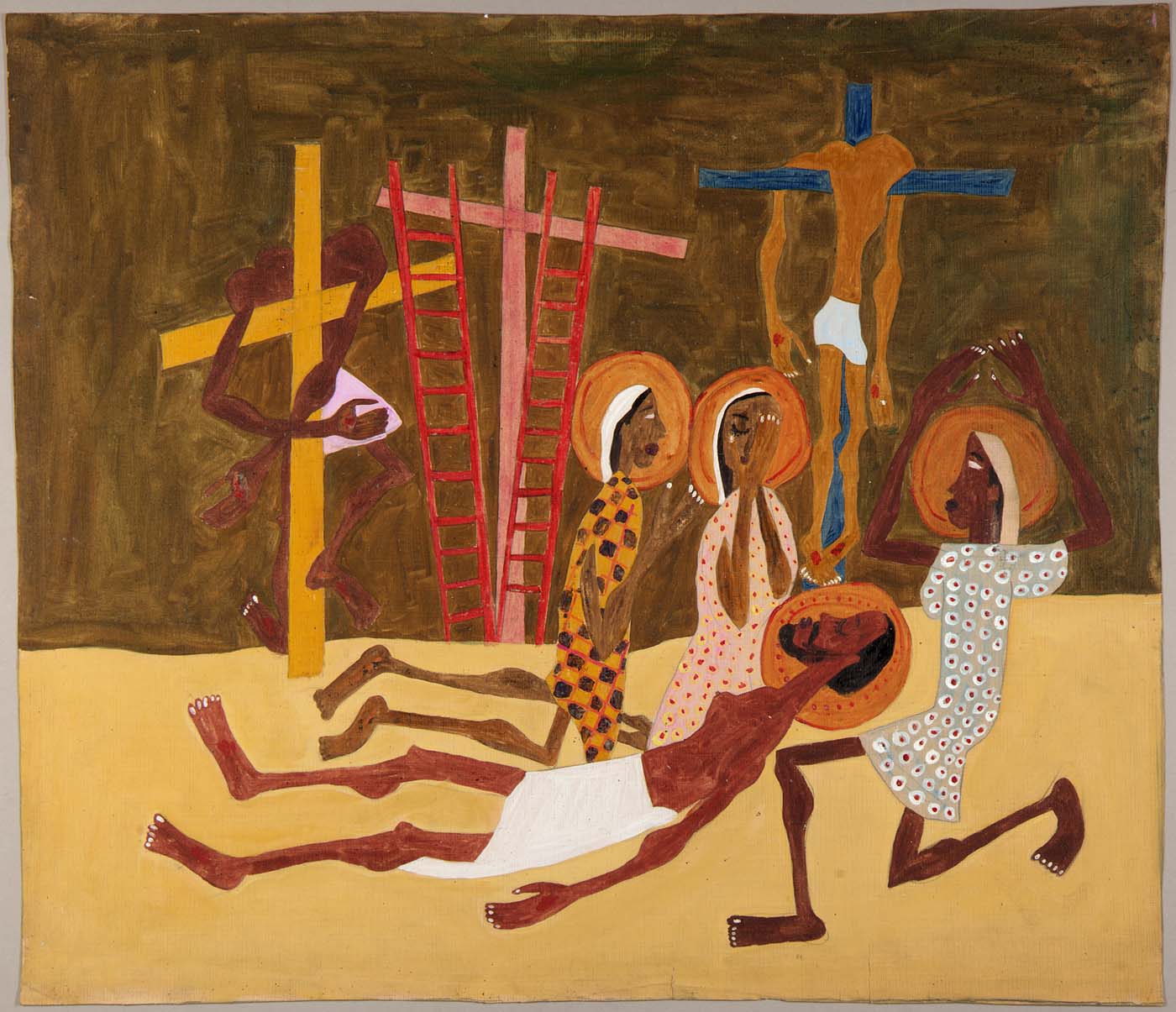
Lamentation, 1944, tempera and pencil on paper 19 1/4 x 22 3/8 in. Smithsonian American Art Museum, Gift of the Harmon Foundation, used with permission.
Let My People Free, 1945, oil on paperboard 38 1/4 x 30 in. Smithsonian American Art Museum, Gift of the Harmon Foundation, used with permission.
Burned Out, 1943, oil on wood 32 1/2 x 26 1/2 in. Smithsonian American Art Museum, Gift of the Harmon Foundation, used with permission.
Chain Gang, 1939, oil on plywood 45 3/4 x 38 1/2 in. Smithsonian American Art Museum, Gift of the Harmon Foundation, used with permission.